Delivery
Legacy System Modernization Without a Multi-Year Freeze
Legacy system modernization without a multi-year freeze: run old and new in parallel, rebuild from a living specification and prove parity before you cut over.
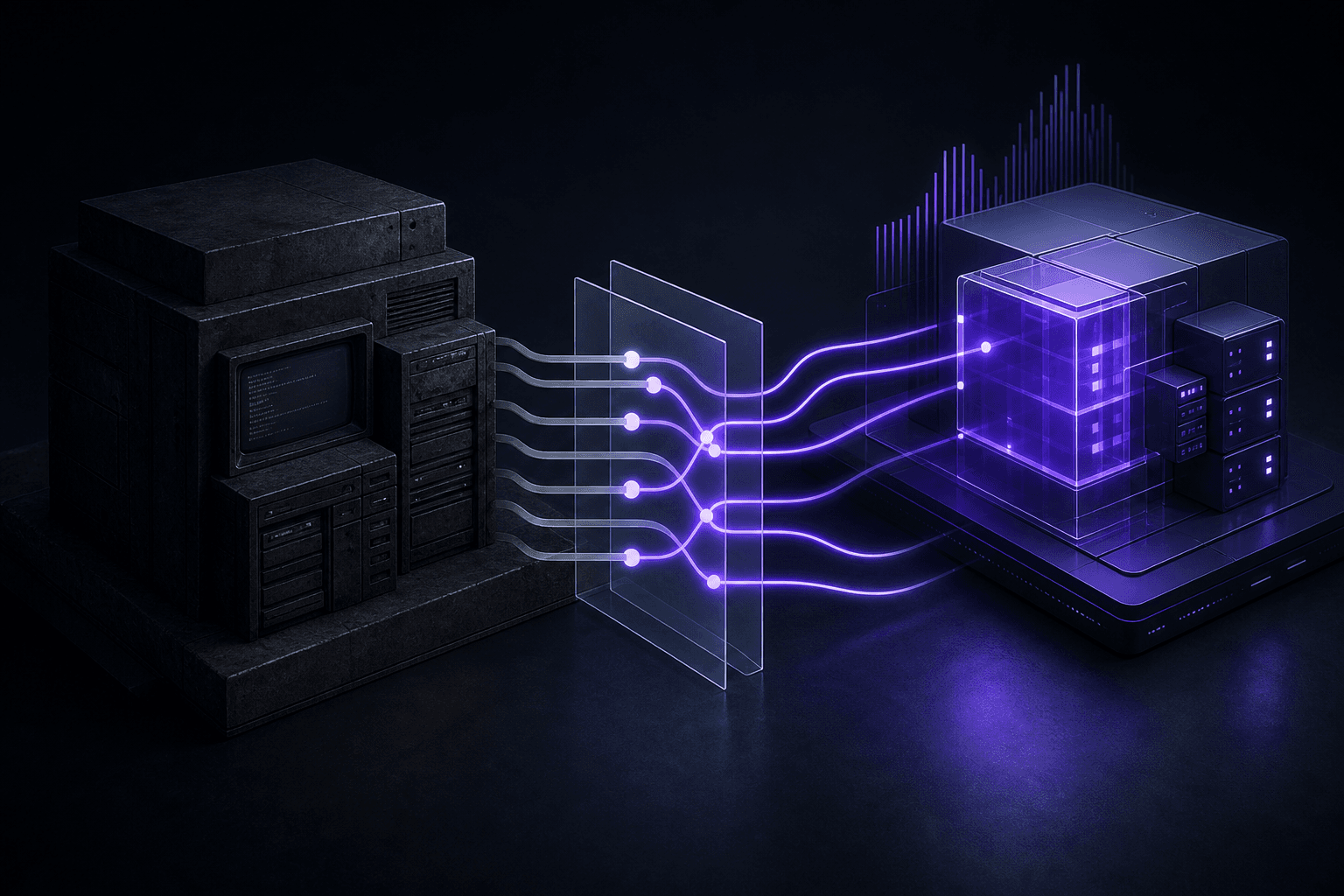
Legacy system modernization is one of the most consequential decisions an engineering leader makes, and one of the most often botched. The usual instinct is to plan a full replacement, freeze new feature work and execute a big-bang cutover. That instinct is wrong, and the cost of following it is measured in locked-out customers, regulatory findings and large write-downs.
The system that runs your business is usually the one nobody wants to touch. The people who wrote it have moved on. The documentation is years out of date. The real question is not whether to modernize. It is whether you can do it without stopping the business while you do.
Why the cost of waiting keeps rising
Legacy systems are not just a technical liability. They are a budget trap.
According to the US Government Accountability Office, about 80 percent of the more than $90 billion the federal government planned to spend on IT in fiscal year 2019 was for operating and maintaining existing systems, leaving little for new capability. The same pattern shows up in financial services, aviation, insurance and telecom.
Stripe's Developer Coefficient study found that the average developer spends more than 17 hours of a roughly 41-hour week on maintenance, technical debt and bad code. That is close to half of your most expensive resource doing work that creates no competitive advantage.
The longer you wait, the more the system hardens. Documentation disappears. The engineers who understood it leave. Integrations multiply. Every year of delay makes the eventual modernization more complex and more expensive.
Five approaches to legacy system modernization
Not every modernization is the same. The right approach depends on how critical the system is, the quality of the existing code, the regulatory environment and how much disruption the business can absorb.
- Rehost: move the system to new infrastructure with minimal code change.
- Replatform: move to a new platform with targeted changes, such as a managed database or runtime.
- Refactor: restructure the existing code to make it maintainable without changing what it does.
- Re-architect: rebuild parts of the system on a new architecture, such as services instead of a monolith.
- Replace: retire the system or a component and move to a new build or a commodity product.
Most enterprises combine approaches: refactoring some components, re-architecting others, replacing commodity functions outright. The mistake is treating any of them as a single, synchronous project.
Why big-bang cutovers fail
The appeal of a big-bang rewrite is clarity. One cutover date, one system in production, no parallel running costs. It feels decisive. It is also how modernization projects fail.
The structural reason is not poor planning or weak engineering. You cannot fully specify a system's behaviour until you have run the new version against real production load, and by then a big-bang cutover has already burned the bridge back.
TSB's 2018 core banking migration in the UK is the canonical example: when the cutover went wrong, large numbers of customers could not access their accounts, and the bank faced regulatory action afterwards. The root cause was not a single technical failure. It was the shape of the migration: everything moved at once, with no fallback.
The lesson is not that rewrites are impossible. It is that all-at-once cutovers remove your ability to recover when something goes wrong, and something always goes wrong.
Start by reading the legacy, not guessing
Most modernization projects fail before the first line of new code, because they start from assumptions instead of facts.
The alternative is to start by reading. The existing codebase is analysed and the requirements it actually implements are reconstructed: the rules buried in the legacy, the exceptions, the special cases, the logic that exists only because a regulator once asked for it. Those become a living specification the team can read, question and trust. Modernization stops being archaeology and becomes engineering.
That specification has to stay true. Every recovered rule links to the code it came from and to the blueprint that will replace it. On each change, code is checked against the blueprint and the blueprint against the requirement, so the new system stays faithful to what the old one did instead of drifting the moment it ships. For a deeper look at this first step, see business rule extraction from code.
How to run old and new in parallel
The strangler-fig pattern is the structural answer to big-bang risk. The name comes from the strangler fig, which grows around an existing tree and gradually replaces it while the host keeps standing.
In software terms, specific capabilities or traffic slices are routed to the new system while the legacy system keeps handling everything else. The new system grows, the legacy system shrinks, and at no point is the business frozen. A few things have to be in place:
Traffic routing and feature flags: a proxy or gateway that can send requests to either system based on configurable rules, designed in from day one.
Shared data or synchronised state: both systems must agree on the state of the world, through dual writes, event sourcing or a canonical data layer. Neither becomes the sole source of truth until the cutover is complete.
Incremental scope: one bounded context at a time, such as a payment module, a customer identity service or a pricing engine, each with a defined rollback path.
Clear exit criteria: a legacy component is retired only after its replacement has run in production, under real load, for a defined period and passed parity validation.
Structuring the work into work orders, each with its own acceptance tests and dependencies, lets several systems move at once without colliding.
Parity validation: making the legacy system the oracle
Parity testing is what makes parallel running trustworthy. For any given input, the new system must produce the same output and the same state changes as the legacy system. When documentation is missing or incomplete, which is almost always, the legacy system's actual behaviour becomes the oracle.
This matters more than most teams expect. Legacy systems accumulate undocumented behaviour over decades: an edge case handled by a COBOL subroutine written in 1994, rounding logic that was never in a spec, a tax calculation patched after a regulatory change and never documented. The new system has to replicate all of it, not just what the surviving documentation describes.
Parity testing runs both systems against the same inputs: production traffic replays, synthetic test suites and adversarial edge cases. Discrepancies are findings, not failures. Each one is investigated: is the legacy behaviour correct and to be preserved, or a bug the new system should not copy? Done by hand, this is slow. Automated, it is tractable, and it is the only honest way to declare the new system ready.
Where AI helps, and what governance it needs
AI changes the economics of the reading and rebuilding work. Agents can ingest a legacy codebase, map its dependencies, reconstruct requirements from observed behaviour and produce modern-stack equivalents far faster than a manual effort.
But "AI wrote it" is not the same as "this is safe to ship". That gap is where modernization programs using ungoverned AI tooling pick up new risk even as they retire old code. The governance requirements are specific:
Agents propose, they do not merge. Every artifact, whether a requirement, a blueprint or a generated module, passes a human approval gate before it enters the delivery pipeline.
The approval is on the record. The audit trail shows what was proposed, who approved it and when.
In regulated environments this is not optional. Financial services firms under SOX, aviation systems under DO-178C and insurers under Solvency II cannot simply assert that a modernized system behaves correctly. They have to prove it with records that survive an audit.
The legacy codebase is intellectual property. The new system and the generated code need to be owned by the enterprise, not retained by a vendor or locked into a proprietary stack.
What to look for in a modernization approach
Before committing to an approach or a delivery partner, ask directly:
Does the legacy system keep running in production throughout, or does the approach require a freeze?
Is there a defined parity validation process that uses the legacy system as the behavioural oracle?
Do AI agents propose changes, or merge them on their own?
Is there a human approval gate before generated code reaches production, and is that approval recorded in the audit trail?
Who owns the generated code, the IP and the audit records at the end of the engagement?
Can the new system run on-premises, in a private cloud or air-gapped?
What happens to the legacy codebase data after the engagement ends?
These are not procurement formalities. They decide whether a modernization can be defended to a board, a regulator or a customer who was locked out during a failed cutover.
How lumaq approaches this problem
lumaq is the AI-native software factory: one control plane across the SDLC, from requirements to blueprints, work orders, build and feedback. For legacy modernization, lumaq reads the existing codebase and reconstructs its rules as a living specification, then rebuilds the system on an owned stack while the legacy keeps running. Agents propose at every stage, and one human approval gates every release.
The legacy system stays in production while the new system is built, validated against it and cut over in slices, not in a single event. Parity validation uses the legacy system's behaviour as the oracle. The output is standard, documented, exportable software in your environment, with an audit trail running from the old rule to the new commit. Code, IP and the audit record belong to you, and lumaq can run on-premises, in a private VPC or air-gapped.
You do not have to choose between the debt you have and the freeze a rewrite demands. Read the legacy, rebuild it faithfully and keep the business running while you do.
Tell us what you need to modernize. Book a scoping call. Read more: application modernization services.
FAQs
What is legacy system modernization?
Legacy system modernization is the process of rehosting, replatforming, refactoring, re-architecting or replacing ageing software systems to reduce technical debt, improve maintainability and enable new capabilities, while keeping the business running throughout.
What is the strangler-fig pattern and why does it matter?
It is an incremental approach in which new components are built alongside the legacy system and gradually take over its functions. It avoids big-bang cutover risk by keeping the legacy system in production as a fallback until each new component has been validated.
What is parity testing in legacy modernization?
Parity testing checks that the new system produces the same outputs and state changes as the legacy system for any given input. When documentation is incomplete, the legacy system's actual behaviour is the authoritative definition of correct behaviour.
How do you modernize a system nobody fully understands?
Start by reading it. Reconstruct the requirements the code actually implements, including undocumented rules and exceptions, into a living specification, and rebuild against that specification instead of against assumptions.
What governance does AI-assisted modernization require?
Agents should propose changes, not merge them. Every generated artifact needs a human approval gate before it enters the delivery pipeline, and that approval must be recorded in the audit trail. In regulated industries this is what makes the modernization auditable.
Who should own the code and IP produced during a modernization?
The enterprise: the generated code, the new system and the audit trail. Vendor retention of codebase data or generated IP creates commercial and regulatory risk, particularly where data sovereignty and IP ownership are regulated.